The short version
What a simple LEGO® SERIOUS PLAY® exercise reveals about team alignment, shared understanding, and the way we work together.
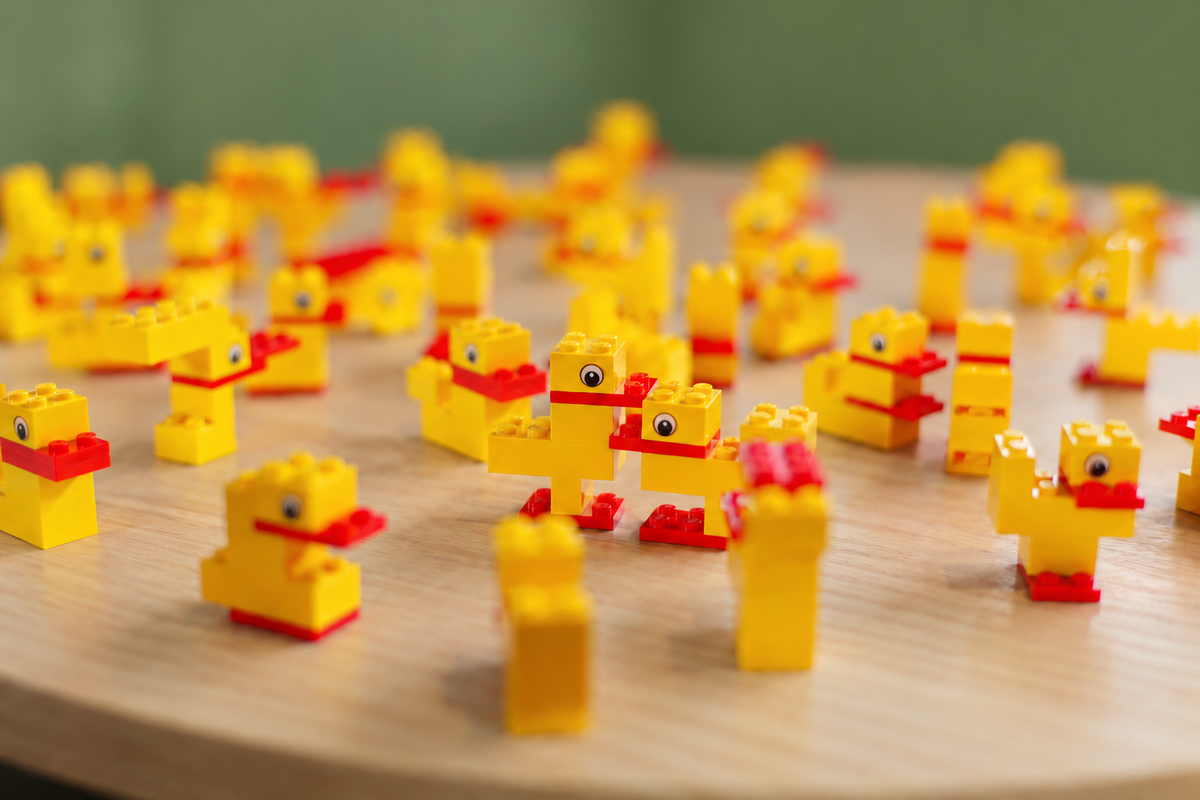
Give a group of people six LEGO bricks and one simple instruction: Build a duck.
Same materials. Same instructions. Same amount of time.
You would think the ducks would look somewhat similar, wouldn't you?
Well, not quite.
One has a long neck, another has a disproportionately large head, one looks like it's swimming, and another barely resembles a duck at all. Yet everyone has completed the task, and everyone can explain why their creation is, indeed, a duck.
This is one of the exercises I use in my LEGO® SERIOUS PLAY® workshops, and it's a wonderful way to introduce something we tend to overlook in organizations: We can have the same information and walk away with completely different interpretations.
Here's something even more fascinating.
Mathematicians have calculated that just six identical LEGO bricks (the standard 2×4 bricks, to be precise) can be connected in 915,103,765 different ways. That's more than 915 million possible structures using only six pieces!
Now, I didn't ask anyone to create 915 million structures. I asked everyone to build the same thing: a duck.
And yet, look at what happens.
We all start with the same instruction, but bring different experiences, assumptions, perspectives, and ideas about what a duck should look like.
Now imagine what happens in the workplace.
A leadership team spends hours developing a strategy. They present it to the organization through a beautifully designed deck, explain the priorities, answer a few questions, and leave feeling confident that everyone is aligned.
After all, everyone attended the same meeting. Everyone heard the same message. Nobody raised an objection.
But the CFO walks away thinking the priority is operational efficiency. The marketing director hears a mandate to accelerate growth. The operations team understands that stability and consistency must come first.
Same strategy. Different ducks.
And here's what interests me: none of them is necessarily wrong.
We interpret information through the lens of our responsibilities, experiences, incentives, and assumptions. We notice different things. We see different possibilities. Sometimes, we even define success differently.
This diversity of thinking is incredibly valuable. In fact, I would worry about an organization where everyone builds exactly the same duck.
The problem isn't that we build different ducks. It's that we assume everyone has built the same one.
We confuse communication with shared understanding.
At work, we often mistake sharing information for creating shared understanding. We mistake silence for agreement, a nod for alignment, and attendance at a meeting for commitment.
Then, weeks or months later, we discover that teams have been moving in different directions. Priorities conflict, decisions get revisited, work gets duplicated, and another meeting is scheduled to get everyone "back on the same page."
We call it a communication problem or an execution problem. Sometimes we even question people's accountability.
But perhaps we never created the conditions for people to make their interpretations visible in the first place.
And I don't think the answer is to demand consensus or make everyone's ducks identical.
It's to get curious about what people have understood, what they're assuming, where their interpretations differ, and which of those differences actually matter.
What if we made our thinking visible?
This is one of the reasons I love facilitating with LEGO® SERIOUS PLAY®.
It's much more than building with bricks or having a playful team-building experience.
The methodology uses hands-on building, metaphor, storytelling, and structured reflection to help people express ideas, explore assumptions, and make abstract thinking visible.
In a traditional meeting, the loudest voices can dominate, while others might have important perspectives they never get the opportunity to share.
With LEGO SERIOUS PLAY, everyone builds, everyone shares, and every perspective gets space in the conversation.
I use the methodology in workshops with leadership teams and organizations to explore team identity, strategic alignment, collaboration, and the ways people work together.
And while LEGO is one of my favorite facilitation tools, the underlying principle applies to any team, whether or not there are bricks on the table.
Imagine ending your next strategy meeting by asking everyone to independently write down what they believe was decided, what success looks like, and what they will do differently on Monday morning.
Then compare the answers.
You might discover that your team is more aligned than you thought. Or you might uncover five perfectly reasonable but conflicting interpretations before they turn into five competing initiatives.
To me, that's what better ways of working are about. Not eliminating differences, but creating the everyday practices that allow people to think differently and still work effectively together.
Because alignment isn't something leaders announce. It's something teams continuously create.
And maybe the next time we finish a meeting and everyone nods in agreement, we should resist the temptation to assume we're looking at the same duck.
We might want to ask everyone to show us theirs first.
What would your team's ducks look like?
At Organizational Intelligence Studio, I design and facilitate LEGO® SERIOUS PLAY® workshops and other collaborative experiences that help teams make their thinking visible, challenge assumptions, build shared understanding, and rethink how they work together.
Whether you're bringing a leadership team together around a strategy, strengthening collaboration, or looking for a more meaningful team-building experience, I'd love to explore what we could build together.
Explore a LEGO® SERIOUS PLAY® workshop with Organizational Intelligence Studio.
Or start by taking our How We Work Check to explore where your team's everyday ways of working might be creating unnecessary friction.